Though his second published novel, Hodge’s 1989 Oasis was his first written, and his impressive debut takes readers back to nascent adulthood, pitting its protagonist with a bevy of hard choices, these made all the more impossible as everything he loves is torn apart.
I often catch myself mentally branding authors with a sort of character sheet and traits I find consistently at work with writers I read a lot. For Hodge, three stand out with everything of his I have read: an ability to characterize suffering and loss poignantly and with masterful human behavioral observation, protean and ever-evolving premises engaged in his stories, and, to put it succinctly, he’s never boring.
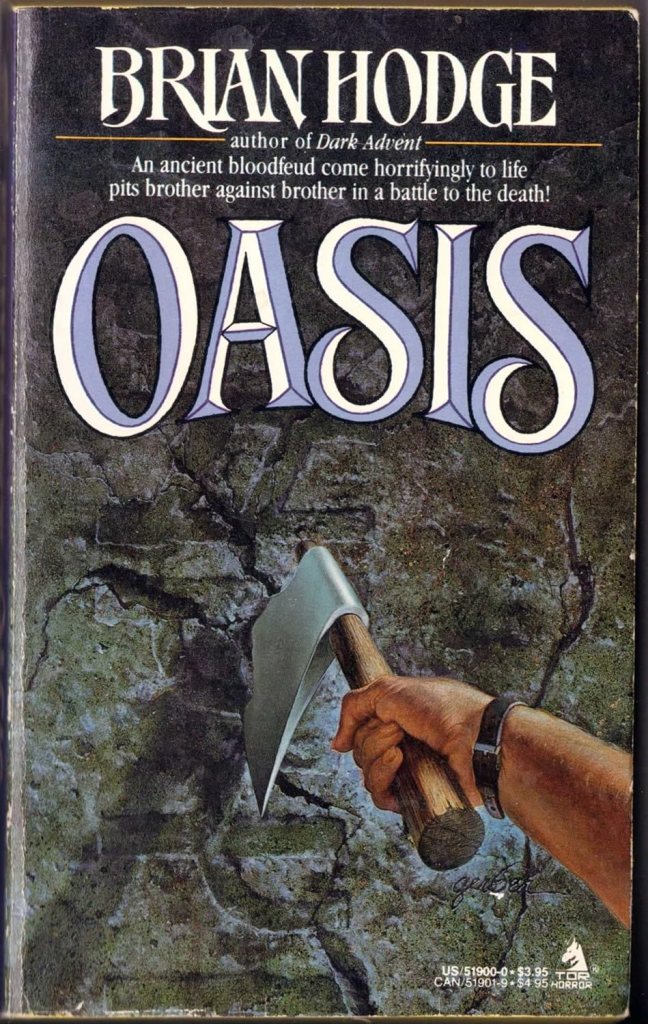
Oasis adeptly captures the ambivalence of encroaching adulthood with one of the first true terrors young people face: a realization that the long-awaited “freedom” of adulthood brings a slew of everyday agonies that quickly replace the minor torments we envisioned as actual afflictions. Chris and his best friends Rick and Phil are on the cusp, the rest of their lives fated to begin after one final summer in their small town. Inseparable since the seventh grade, this trio each nervously eye three different futures: college for Phil, a chance at rockstardom for Rick, and uncertainty for Chris.
It’s refreshing to read about whole families and plausible characters and to witness how traumas are perceived by a cogent community that reads entirely believable. The malignant threat lurking builds slowly, with Hodge skillfully weaving a horrific prologue’s events into the slow discovery Chris and company uncover: the abandoned housing division and planned community Pleasant Hills, which they dub Tri-Lakes. With half-paved roads buckling before an overgrown waterfront lot with monstrous, deformed trees standing sentinel before it, the gang adopts the space as their new drinking and necking place. Yet, with each visit, Chris begins to notice the vacated land seems to enervate baser and disturbing aspects of the friends’ personalities.
As the threat grows, we meet Aaron, Chris’s brother. The bond between these brothers is the narrative glue, with Aaron lagging two years behind Chris and working his same miserable restaurant job while Chris toils for the county under the guidance of “White Trash Joe,” the area’s local folklore dispenser and sometimes arms dealer. Chris alternates time at Tri-Lakes with his friends and girlfriend, Valerie, and things escalate.
The trio’s taste for beer becomes ravenous. When Chris finds a few boys from a rural outlying community “trespassing,” words quickly turn to blows, a brawl that propels Chris into a homicidal rage he only grasps once he flees the area. Even once free of Tri-Lakes, the intensity has worked its way into Chris, inciting him to sexually assault Valerie. But when he is driving home and collides with the body of a man who went missing at Tri-Lakes weeks staggers into his path, Hodge’s stealth and slow-burn flares.
The entire trip home consistent of side streets, narrow little lanes with rows of sleepy houses. Many of the blocks were well lined with trees that grew huge and shady by the curb … neighborhoods that forever worry the parents of small children, because if their child should suddenly pop out from behind a tree into the street, why, the driver of an oncoming car might never have time to stop.
Hodge 34
Just as I didn’t. The fact that it wasn’t a child was no consolation.
He simply stepped out from behind a tree and stood there. In that split second when I knew what was going to happen and felt my heart clawing its way up my throat, it looked almost as if he were waiting for it.
Hodge’s knack for crisp action and varied sentence structure plays well here. Long, spiraling sentences will give way for short, declarative ones (“Just as I didn’t.”), and oftentimes disarm in a way you don’t expect. Beyond the visceral, though, Hodge deftly captures smaller pains, the kind that linger. When Christ attends the service for one of his friends, he reflects:
That’s another thing, a dead kid’s friends never want to leave the funeral home, or the church. They clump together in subdued little groups, hands in pockets or arms crossed over chests, looking to the sky and the ground for answers that never come. They cling to one another. Not physically, but emotionally. Because they know there are no guarantees someone else won’t buy it on the way home.
Hodge 111
It’s this level of authorial observation that makes each short chapter in Oasis perform — never, even during scenes where the characters are having a mundane talk or speculate on the consequences of things, does Hodge resort to stock narration. There’s depth, with punchy endings to each chapter, and by the time the true menace becomes clear (an artifact suspending a curse that allows the evil of two Viking brothers to infect the minds and feelings), the narrative is already sufficiently compelling that we care about the fate of the missing and the wounded. The final gut punch when things come to a head later in the novel hits in a way that feels both inevitable and equally tragic.
A fast read with compelling characterization and an unconventional villain whose malignance pervades nearly every scene, Oasis will appeal to readers who nostalgically look back and wonder what-if…that is, if they would barter their trip back in time to risk a spectral Viking Valhalla-bent on separating their head from their shoulders from joining the revery.
 The Macabrary