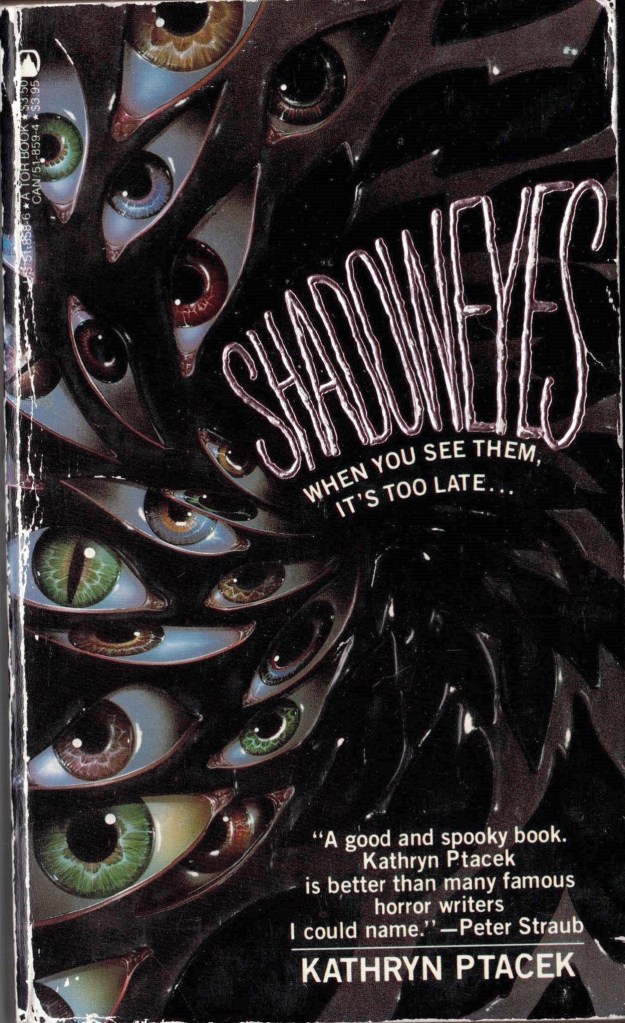
After writing and publishing for 4 years under 3 pseduonyms, Kathryn Ptacek’s 1984 Shadoweyes became the first title published under her name. In the 36 years since its publication, the formula and structure will read familiar to horror fans…
After a prologue with some victim-to-be strawmen and one minor character who will provide nominal assistance later, a series of back-and-forth butcherings introduce a mostly unseen threat: that of the shadoweyes, the eponymous creatures that will set the novel’s protagonist, Chato Del-Klinne, upon a find-his-roots journey, all before it’s too late. Whilst King and many other horror greats often speak about the power of omitting outright descriptions of monsters and creatures and allowing the reader to create a powerful image of their own horror, I would argue that Shadoweyes takes this maxim too far, as that the actual creatures, even in the book’s climax, are never seen. In the final confrontation between Chato, and the creature’s servitor Junior in the pueblo lair of the beasts, the following is the closest we get to a description of the shadoweyes themselves:
He whirled and stared into the flat eyes of the creature. It hissed at him…They were all around him, shades everywhere, the shadoweyes crowded into the chamber…Talons, colder than the icy stream, raked across his bare shoulders, down his thigh, bringing bloody welts (299-300, 304)
This pattern repeats throughout the book: seemingly incorporeal, razor tooth, taloned meanies chew and hack like Gremlins, but always fade away. In what might be the book’s most interesting encounter with them, they overtake a hot air balloon festival and send one balloon careening into the festival. The resultant fiery explosion napalms those on the ground, and in its wake, the shadoweyes wash over the unsuspecting populace of Albuquerque and off two of the novel’s three antagonists, the secret triumvirate preserving the secret of a stolen fetish.
The rotating 3rd POV perspective allows us moments with these villains (a mayor, monsignor, and senator), while the narrative conceals the semi-puppet master in the darkness, hinted at as less harmless in the prologue: Junior Montoya, the “half-breed” who obeys the whims of the shadoweyes to eke out a living ripping off tourists. While the villainy and Indigenous lore would do well to anchor the novel’s threats, poor development and strange actions for the novels’ auditioning protagonists, Susan and Laura, made it difficult to connect.
After a few chapters of watching the shadoweyes massacre the unsuspecting, we’re introduced to Chato as he returns to Albuquerque where he once worked as a promising tenure-track professor. In time, the important details of his abandonment of the old ways will become the focus of the book; instead, Ptacek spends 5 full pages giving us everything Chato has been doing since, none of which seems to factor or resolve anything later in the novel. Similarly, the intrepid reporter, Laura is hinted to take a starring role, aiding Chato earlier on and even sleeping with him. But like Chato, Laura isn’t given much development, and in her case, she devolves into a coward who disappears into the novel’s background when Susan, the “whore with the heart of gold” prostitute, teams up with Chato. After a roll in the sleeping bag with Susan on the floor of Laura’s apartment (while she is in the other room, no less), Susan drives Chato out to face the big bad and in true hero fashion, Chato insists he must do so alone, affirming the cliche and supporting what many readers have said: Chato should have been/truly is the sole protagonist.
A frustrating element in Shadoweyes is the repetition of both Chato and Laura sniffing out a clue, pursuing it, and then entirely dropping the matter when confronting the individual who can confirm or deny their suspicions. Laura works hard to get an audience with the Senator, and then shies away. Chato confronts Junior (only to be put to sleep through never-revealed powers), spends a night in jail for alluding to threats to the mayor (and is easily bailed out), and goes to meet with a shaman for help, only to walk away angry and disaffected. This is not the essential “try and fail” method of escalating conflict: it’s scenes that don’t translate as dramatic or eventful.
Rushed character backstory, obligatory violence scenes, obscurely rendered monsters, formulaic antagonists are all low point, but the interesting villain, Junior, is unfortunately glossed over. Salvageable and interesting, Junior Montoya’s involvement, Chato’s shamanistic training and reconnection to “the old ways,” and the origins of the black fetish stone all would have benefited from expansion as they both detail Chato’s arc and the novel’s cool premise elements that take a backseat to the investigation . The first of several of Ptacek’s Native American horror-themed and troped stories, Shadoweyes reads like much early 80’s horror, but has its moments (did I mention the hot air balloon massacre?).
 The Macabrary